Comparing Henley Royal Regatta Bracketing to Wimbledon
Does the Draw on the Thames Produce the Best Racing?

JULY 10, 2025: Is the Henley Royal Regatta draw producing compelling matchups? The storied rowing event, which crowns champions across more than a dozen knockout competitions, continues to rely on a draw system steeped in tradition and subjectivity. This approach stands in sharp contrast to the structured, ranking-based bracketing systems used in other elite sporting tournaments, such as Wimbledon and NCAA basketball’s March Madness.
While Wimbledon, Henley’s summertime counterpart on grass, mixes ritual with algorithmic precision, the rowing regatta on the Thames adheres to a more opaque model. At Wimbledon, 32 of the 128 players—25 percent of the field—are seeded based on ATP or WTA rankings, calculated from points earned over a rolling 52-week window. These seeds are placed strategically in the bracket to prevent early-round clashes between top contenders: the top two are assigned to opposite ends of the draw, seeds 3 and 4 to separate halves, seeds 5 through 8 to different quarters, and so on, in increasingly fine-grained distribution tiers. The remaining unseeded players—including qualifiers and wildcards—are slotted into the draw through a public computerized process. Though Wimbledon retains the traditional draw boards and a ceremonial announcement, the structure is ranking-driven and digital at its core.
Henley, by contrast, follows a system that is less transparent and more discretionary. As described by Wikipedia editors, “The draw is a public event that takes place in the Henley Town Hall, normally at 3 p.m. on the Saturday before the regatta. For each event, the names of all selected crews are placed on pieces of paper which are then drawn at random from the Grand Challenge Cup. These crews are then placed on pre-determined positions on the draw chart, as far apart as possible. The remaining qualifying crews are then drawn from the cup, filling in from the top of the draw chart downwards, until all places have been filled.” (Wikipedia, source)
In practice, this means that a very small number of “selected” or “outstanding” crews—chosen informally by the Stewards—are placed in such a way as to avoid early collisions, while the remainder of the field is assigned randomly. There is no formal seeding system, nor any public documentation of which crews have been protected.
Does It Work? A Data-Driven Analysis of Race Tightness
To evaluate whether this method produces progressively more competitive racing, I analyzed all matchups from the 2017 through 2025 Henley regattas for events typically running three or more days (excluding, for example, the Grand Challenge Cup, which in recent years has had too few entries to stage a full bracket).
I compared race verdicts—measured both in traditional lengths and converted to meters based on shell type—across rounds and across the regatta week. Three key questions guided the analysis:
- How do margins change from heats to semi-finals to finals?
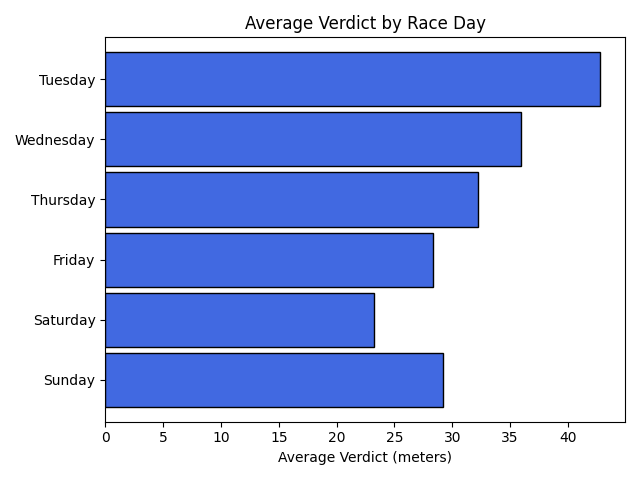
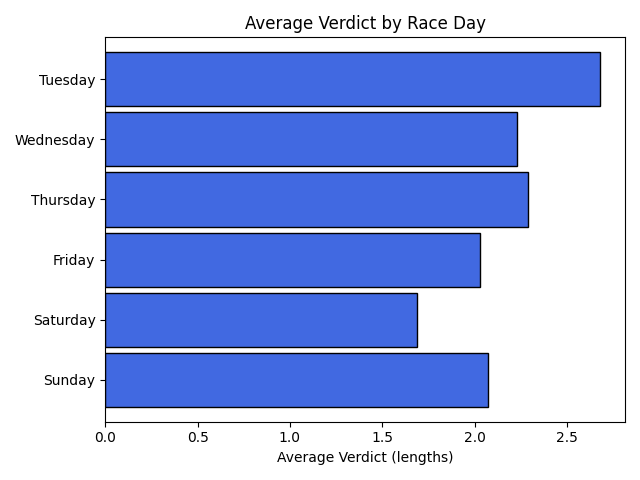
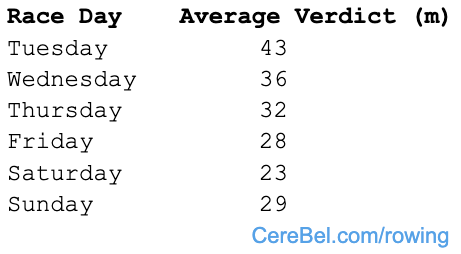
- Do margins narrow from early rounds (Tuesday) to finals (Sunday)?
- How often does a crew’s winning margin shrink as it progresses through the draw?
Findings: Consistent Tightening as Rounds Progress
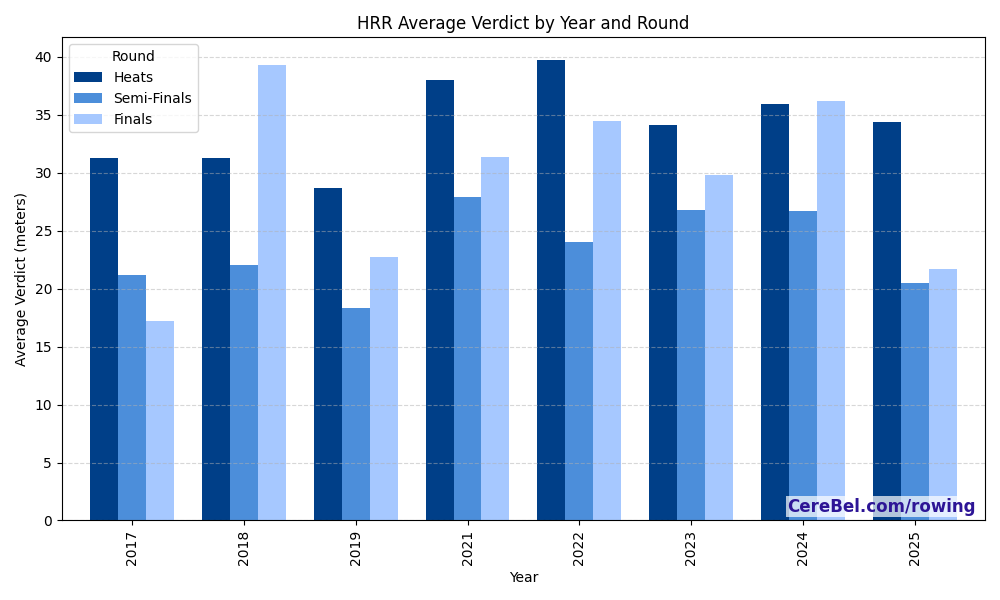
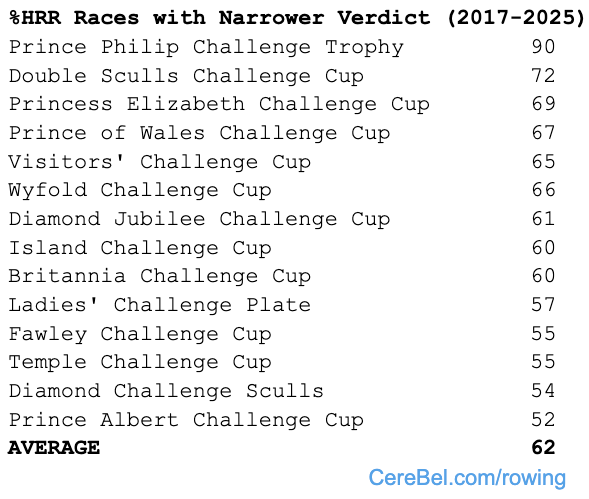
Across all years studied, semi-final margins were narrower than in the heats. In every year except 2018 and 2024, final margins were also tighter than heats. Curiously, however, finals often featured larger margins than semi-finals. Open to theories what this might suggest?The trend held when comparing margins from Tuesday through Sunday: on average, about 60 percent of matchups showed narrowing margins over the course of the week. This degree of tightening exceeds what would be expected from a fully random draw and even surpasses comparable figures from Wimbledon.
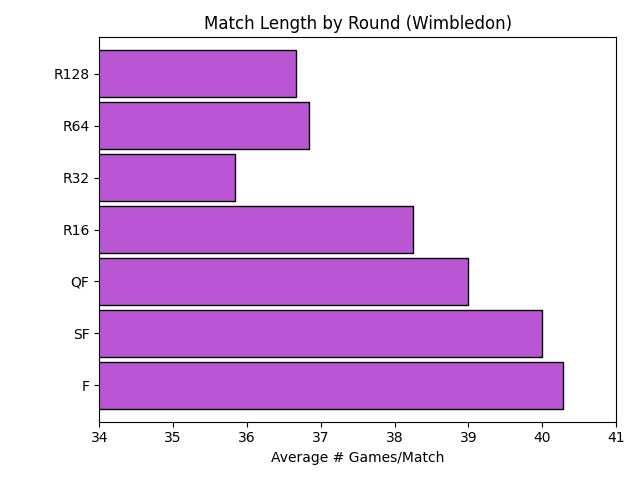
At Wimbledon, match competitiveness generally increases as the tournament progresses, measured by the number of games per match. But the increase in rowing margin tightness—despite the lack of formalized seeding—suggests that Henley’s informal bracketing still succeeds in setting up climactic later rounds.
Results
Changes in Race Verdicts between Heats, Semi-finals, and Finals
In every year of this subject range, margins tightened in Semi-finals over Heats and in every year but two (2018 and 2024), tightened in the Finals over Heats.
Changes in Race Verdicts from Tuesday to Sunday
This phenomenon is also reflected in a comparison of winning margins from the early round Heats to the Sunday Finals.
Progressive Verdict Tightening
This phenomenon is also reflected in a comparison of winning margins from the early round Heats to the Sunday Finals. This table reflects the percentage of individual races in which the winner's margin of victory was tighter than that competitor's earler races.
Wimbledon
These tightening verdict progressions are comparable to the increasing competitiveness of Wimbledon matches in successive tournament rounds as measured by the number of games played by match (years 2017-2024). NOTE: Prior to 2020, Wimbledon seedings include a grass‑court advantage formula. Will soon publish some interesting findings in that regard uncovered in the course of this research.
Questions or comments? Click contact in lower right corner (may need to rotate phone). Cheers.